
News and Updates
MEMO: Addressing Household Affordability Through Safer, More Connected Communities and Transportation Choices
America’s cities need transportation policies that help families, improve safety, and give local leaders the tools to meet the needs of their communities. Federal transportation policy should reflect the realities cities face every day: rising costs, persistent safety challenges, increasing extreme weather events, and growing demand for practical, reliable transportation options. This document outlines Climate Mayors priorities for the reauthorization of the surface transportation bill. To ensure proper stewardship of taxpayer dollars for investing in lasting transportation infrastructure that is less vulnerable to disasters, we urge Congress to fund the priorities outlined below in the reauthorization.
Direct More Funding to Local Governments to Select Projects for their Communities
Local governments maintain more than 75% of the nation’s roads, yet they only receive and manage about 15% of federal transportation funding. Cities need greater access to federal funding without State interference that can slow the obligation of federal funds, so they can fix the roads, improve the freight corridors, and develop the community infrastructure that matters most to residents. Federal policy should empower local leaders to respond to local needs with flexibility, speed, and accountability. To better align federal investments with locally determined projects, Congress must:
Increase suballocation of the Surface Transportation Block Grant Program (STBGP) from 55 percent to 65 percent;
Maintain suballocation for Carbon Reduction Program at 65 percent;
Include suballocation for PROTECT formula program for infrastructure resilience;
Include suballocation for the Highway Safety Improvement Program (HSIP);
Require suballocated funding to be obligated only for projects selected by local and regional decision-making structures, free of State interference;
Increase funding and the federal share for the Metropolitan Planning Program and enhance inclusions of housing considerations as part of planning processes;
Preserve critical discretionary grant opportunities for localities;
Establish a pathway for MPOs to become direct recipients of planning and capital funds;
Preserve dedicated discretionary grant funding for EV charging infrastructure through which local governments are eligible, prioritizing ride-hailing, multi-unit dwelling, and community charging.
Ensure that Grant Awards and Programs are Fully Implemented and Protected from Arbitrary Cancellations or Impoundment
Congress must take firm legislative action to ensure that all funding from the Infrastructure Investment and Jobs Act (IIJA) and future surface transportation bills are fully implemented as agreed to by Congress and that awarded discretionary grants are allowed to proceed without delay, arbitrary cancellation, or impoundment. Cities and local governments rely on the certainty of federal commitments to plan, finance, and execute critical infrastructure projects that improve public safety, strengthen resilience, modernize transportation systems, and support economic growth. Disruptions to awarded grants undermine local planning efforts, increase project costs, create uncertainty for private-sector partners, and delay urgently needed investments in communities. Protecting the integrity of funding commitments is essential to maintaining trust between federal and local governments and ensuring that infrastructure projects deliver their intended benefits to residents across the country. Congress should not finalize any reauthorization agreement until the last agreement is upheld.
Invest in Infrastructure to Increase Resilience to Extreme Weather
For mayors, investing in infrastructure resilience is essential to protecting the people, businesses, and critical services that communities depend on every day. As extreme weather events become more frequent and severe, aging infrastructure faces growing risks from flooding, heat, storms, and other hazards that threaten public safety and disrupt local economies. Proactive resilience investments help cities modernize transportation networks, strengthen water and energy systems, reduce disaster recovery costs, and ensure continuity of essential services during emergencies. These long-term investments often struggle in the day-to-day haggling over shorter term, more immediately tangible projects when forced to compete. Sadly, the urgency for preparedness is rarely appreciated until it is too late. That is why dedicated funding for resilience is essential. It provides local governments with the certainty needed to plan and implement long-term resilience projects, protecting taxpayers from escalating future costs while creating jobs, supporting economic growth, and building stronger, more sustainable communities. Congress must:
Preserve and invest in the PROTECT formula program, and include 50% suballocation of funding to local governments.
Preserve the PROTECT discretionary grant program
Incorporate resilience projects as eligible under key formula and discretionary grant programs including BUILD, INFRA, and any new discretionary grant programs.
Invest in Safe and Affordable Transportation Options for All Users
Transportation accounts for the second highest cost burden for families, with mounting inflation and gas pricing continuing to squeeze families' budgets even further. This surface transportation bill must recognize that a system that forces Americans to drive gas cars is a system that does not provide them with options to save money, especially at times when gas prices rise. Federal transportation investments should make it easier for consumers to have greater mobility choice, including to drive hybrid and electric vehicles that reduce their total cost of ownership. This also means prioritizing street design, lower-risk infrastructure, and practical improvements that help protect people whether they are driving, walking, biking, or taking transit. Together, these policies not only improve climate outcomes, but will unlock more affordable transportation options that help families save money and access work, schools, and services. We ask for Congress to:
Retain the Safe Streets and Roads for All (SS4A) grant program;
Create a suballocation under the Highway Safety Improvement Program (HSIP) to direct safety funding to serious injuries and fatalities on non-State owned roads;
Increase funding for the Transportation Alternatives Program (TAP) set-aside;
Maintain robust investment levels in federal transit programs, continue to increase the percent share to fund transit programs, and ensure that any new revenue into the HTF includes deposits into the Mass Transit Account, with an 80-20 highway-public transit split;
Restore employers’ ability to deduct the cost of providing the Commuter Tax Benefits;
Preserve dedicated funding for multi-modal mobility projects from programs like the Carbon Reduction Program (CRP), Congestion Mitigation and Air Quality (CMAQ), and Active Transportation Infrastructure Investment Program (ATIIP);
Preserve dedicated federal investments through formula and discretionary grant programs for the installation of electric vehicle charging infrastructure similar to the National Electric Vehicle Infrastructure (NEVI) and the Charging and Fueling Infrastructure (CFI) programs;
Enable high-mileage commercial fleets, multi-unit dwellings, and workplaces to adopt alternative fueled vehicles and infrastructure by extending the 30C Tax Credit, set to expire in June 2026;
Do not punish certain drivers with a punitive EV and hybrid fee. Address the shortfall in the Highway Trust Fund holistically and fairly; and
Provide an optional mileage-based alternative to any annual registration fees to account for drivers’ actual system usage.
Keep Prices Down Through Reliable Movement of Goods and Services
Cities are critical multimodal freight logistics hubs of our transportation system and serve as powerful epicenters for first and last mile freight delivery to complete transportation trips. Federal policy should support freight logistics needed for reliable goods movement, and efficient delivery networks in communities across the country. Investing in medium- and heavy-duty electrification can help build a freight system that is more reliable, less exposed to fuel volatility, and more resilient. With medium- and heavy-duty trucks representing 5% of vehicles yet responsible for 20% of transportation emissions, this support comes with the added benefit of cleaner air and water for cities in busy and high-trafficked corridors. We ask that Congress:
Establish a robust medium- and heady-duty alternative fuel vehicle discretionary and formula program that supports vehicle and fueling and charging infrastructure deployments at strategic shared depot sites and along key freight corridors;
Increase flexibility for cities to support depot charging by allowing such charging to qualify for federal funding if depots serve more than one commercial motor vehicle or are publicly accessible;
Support innovation in last-mile delivery through grant funding for pilot projects and programs; and
Update FHWA Minimum Standards for EV Charging with medium- and heavy-duty specific standards.
MEMO: MAYORS LAY OUT PLANS TO LOWER COSTS, DRIVE CLEAN ENERGY
TO: Interested Parties
FROM: Climate Mayors Executive Director, Kate Wright and Bill Holland, VP of State Policy and Advocacy, LCV
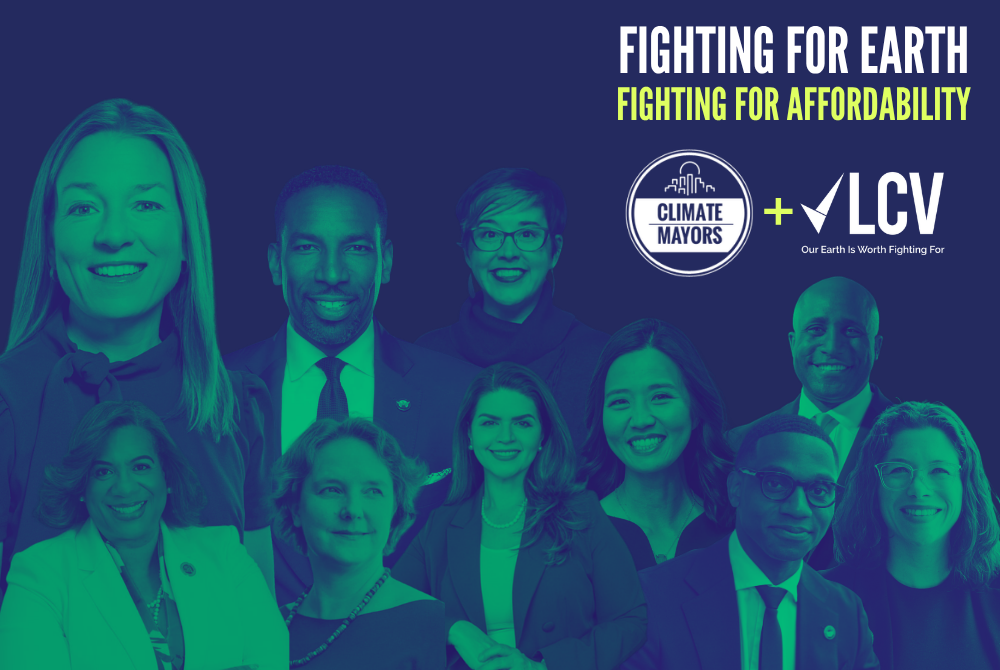
Washington, D.C. (April 20, 2026) - This Earth Week, Climate Mayors is partnering with the League of Conservation Voters to amplify the work of mayors who are investing in climate action and clean energy while delivering relief to the pocketbooks of millions of Americans.
Americans are feeling the impacts of the cost of living crisis and the climate crisis like never before. Energy affordability is reshaping how families experience the broader economy day to day, while rising utility bills and transportation are now one of the fastest drivers of inflation. The Trump Administration’s attempts to ban clean energy and the proliferation of big corporation tech data centers have increased energy prices for working families across the country. For many households, especially low-income families, these expenses compound already high housing burdens, leaving millions behind on electricity payments.
This vulnerability is deeply rooted in our nation’s continued reliance on fossil fuels and aging energy systems. For households already living paycheck to paycheck, particularly younger Americans facing rising vehicle, insurance and financing costs, these fluctuations can be destabilizing.
As the local leaders closest to their constituents, mayors are best positioned to deliver real change to improve people’s lives. Investments in local clean energy advance resilience while improving affordability and strengthening the local economy. Clean energy investments drive down costs for transportation and utilities while making homes more energy-efficient.
Climate Mayors are laser-focused on accelerating renewable energy growth at home to deliver clean, affordable, and reliable energy—faster. Clean energy is the quickest and cheapest way to bring new power to local communities. By implementing proven solutions—from efficiency upgrades and clean energy incentives to streamlined permitting and EV infrastructure—mayors are lowering energy costs and building healthier, more resilient cities. Here are some transformative solutions mayors are delivering to create cleaner, safer, healthier, and more affordable cities.
Mayor Lauren McLean, Boise, ID: weatherization
“Boise is meeting both our housing and climate goals by weatherizing homes in partnership with a local nonprofit, El Ada. Weatherizing homes is a direct investment into our community, by both preserving naturally occurring affordable housing and by ensuring that some of our most vulnerable residents are able to stay in their homes as the daily cost of living increases. In 2025, 123 Boiseans saw improvements on their homes that included fixing and repairing holes in roofs, replacing insulation, repairing heating and cooling systems, and more. Each repair plays a role in lowering energy bills, strengthening community health, and creating a more resilient city where everyone can thrive.”
Mayor Michelle Wu, Boston, MA: efficiency upgrades
“For too many Boston residents and small businesses, high energy costs are a burden that impacts their ability to afford other basic needs. Through the Boston Energy Saver Program, we are making it easier for families, small businesses, and nonprofits to cut energy costs, reduce their reliance on fossil fuels, and build a more affordable and resilient future.”
Mayor Andre Dickens, Atlanta, GA: weatherization and efficiency
“Too many Atlantans are burdened with rising utility bills and higher costs of living across the board. These stresses can be linked to health disparities and negative impacts that have kept Atlanta as one of the nation’s highest energy burdened cities. To support energy affordability and its positive co-benefits, we launched WeatheRISE ATL. WeatheRISE ATL aims to reduce energy load for our most energy burdened households while also providing job training and contractor upskilling in weatherization and energy efficiency sectors.”
“With an initial $2.4 million dollar investment from federal sources, WeatheRISE ATL delivered impactful results. Community canvassers knocked on 5,482 doors and no-cost energy audits and healthy home interventions were provided to over 300 homes. To build upon this success, we established the Atlanta Community Energy Trust Fund. With residents seeking help to address rising utility bills and higher costs of living, the Atlanta Community Energy Trust Fund can invest in common-sense solutions that deliver tangible results. The initial $500,000 investment has already been matched with funding from the private and philanthropic sectors. The public-private-community partnerships like those amplifying WeatheRISE ATL demonstrate the best path to address energy affordability and create whole, healthy and climate resilient cities.”
Mayor Barbara Buffaloe, Columbia, MO: efficiency upgrades and rebates
“Climate Mayors understand that acting on climate and helping lower people’s energy bills are one and the same. Residents are asking for help with their household energy costs, and we are delivering through energy efficiency, smarter energy systems, and through rebates and other tools to help families improve efficiency in their homes. This is how we are creating a more affordable and livable city.”
Mayor Regina Romero, Tucson, AZ: low income solar program
“Here in Tucson, we are taking action. Under my leadership, our council allocated $900,000 to support the installation of solar systems in low-income homes through our Solar Empowerment Program. This investment is about more than clean energy. It is about lowering monthly utility bills for families who need it most and ensuring that the benefits of the energy transition are shared equitably. At the same time, this funding strengthens our local economy. Our nonprofit partners are on the frontlines, working directly with families, guiding them through the process, and installing these systems. As federal funding becomes more limited, these local investments are increasingly critical to sustaining their work and maintaining trusted community relationships. We know that energy policy is economic policy. By expanding access to affordable, clean energy, we are not only reducing costs for residents today, we are building a more resilient, equitable, and locally driven energy future for Tucson.”
Mayor Shawyn Patterson-Howard, Mt. Vernon, NY: Geothermal and heat pump program
“Energy costs are devastating families. Electricity and gas prices in Westchester are among the highest in the nation. This is why Mount Vernon is taking bold action on climate because it’s about affordability for our families. In partnership with Con Edison we are working to build a geothermal network, alongside investments in energy-efficient heat pumps, to lower and stabilize energy bills so residents aren’t forced to choose between staying warm and putting food on the table. Every dollar we save a family on energy is a dollar they can put toward groceries, rent, or their child’s education. Energy price stability isn’t just a utility issue, it is an investment in our local economy that strengthens families.”
Mayor Justin Bibb, Cleveland, OH: upgrading city buildings and solar tax credits
“Energy performance contracting is a tool available to every single local government to get energy savings for city facilities, without having to rely on federal grant funding or burdening local taxpayers. In Cleveland, we are also layering in clean electricity investment tax credits for solar installations as an additional climate action toward our net zero carbon emissions by 2050 goal.”
Mayor Satya Rhodes-Conway, Madison, WI: low income efficiency upgrades, city clean energy and efficiency upgrades
“All of Madison benefits when we keep our city accessible to folks with a wide range of incomes. One way we can help is to reduce the cost of household bills, and we’ve launched multiple programs to do just that. Our MadCAP program gives a credit to low-income households on their Municipal Bill and encourages water efficiency. Our Efficiency Navigator program (run in partnership with Sustain Dane and Elevate Energy) supports energy efficiency upgrades in affordable apartment buildings, lowering utility bills for tenants while requiring that rents remain affordable. Our affordable housing programs require energy efficiency in new construction or major renovations, and our new social housing developments are utilizing geothermal heating and electric appliances instead of natural gas, improving public health and ensuring lower energy bills for tenants. We’ve installed over 2 megawatts of solar on our facilities, and all new City buildings must be at least LEED Gold, saving the taxpayers money. Energy efficiency eases the burden on folks who are struggling financially and helps keep them in their homes, and renewable energy helps buffer families from rising energy costs over time. Madison is working hard to meet our clean energy and affordability goals at the same time.”
Mayor Emma Mulvaney-Stanak, Burlington, VT: comprehensive incentive program: EVs, induction, e-bikes, etc.
“As Mayor, my top priorities have included climate action and affordability, and Burlington is seeking to be a climate-forward city. With the federal government eliminating key incentives for renewable energy and energy efficiency, in Burlington we are focused on continuing progress on our Net Zero Energy Roadmap goals, with key initiatives including Burlington Electric Department’s strong rebates for electric vehicles, EV charging, heat pumps, e-bikes, induction cooking, and so much more.”
“Research from Energy Action Network shows that Burlington drivers can charge an electric vehicle for the equivalent of less than $1 per gallon of gasoline. At a time when higher gas prices at the pump cost Vermonters over $15 million extra in March 2026 alone, helping more of our residents drive electric, and ensuring our community can be walkable and bikeable, is not just a positive from a climate standpoint but from a consumer affordability standpoint as well.”
“As Mayor I’ve also convened a group of climate advisors from across the City Departments as well as community members, and we will be issuing their recommendations for broader climate initiatives including ideas around resilience and adaptation efforts to protect our community, our lands and waters, and our infrastructure from the impacts of climate change.”
Mayor Quinton Lucas, Kansas City, MO: tree planting, composting, energy incentives
“Kansas City is focused on protecting our residents and their wallets from the material costs of climate change. In recent years, we have planted over 13,000 trees to support Kansas City’s urban canopy that keeps neighborhoods cool, clean, and beautiful as temperatures rise. Kansas City continues to distribute food recyclers that bolster our composting infrastructure and reduce food waste community wide. From innovative programs to energy reform, we remain focused on building a climate-resilient Kansas City.”
##
About Climate Mayors
Climate Mayors is a bipartisan network of over 300 mayors, demonstrating climate leadership through meaningful actions in their communities since 2014. Representing 46 states and 59 million Americans, Climate Mayors reflect U.S. cities’ commitment to climate progress. For more information, visit our website and follow Climate Mayors on X,Bluesky, andLinkedIn.
Media Contact: victor@climate-mayors.org
(520) 388-0448